

For many small business owners, today’s evolving work environment raises a fundamental question: What’s the new role of office space?
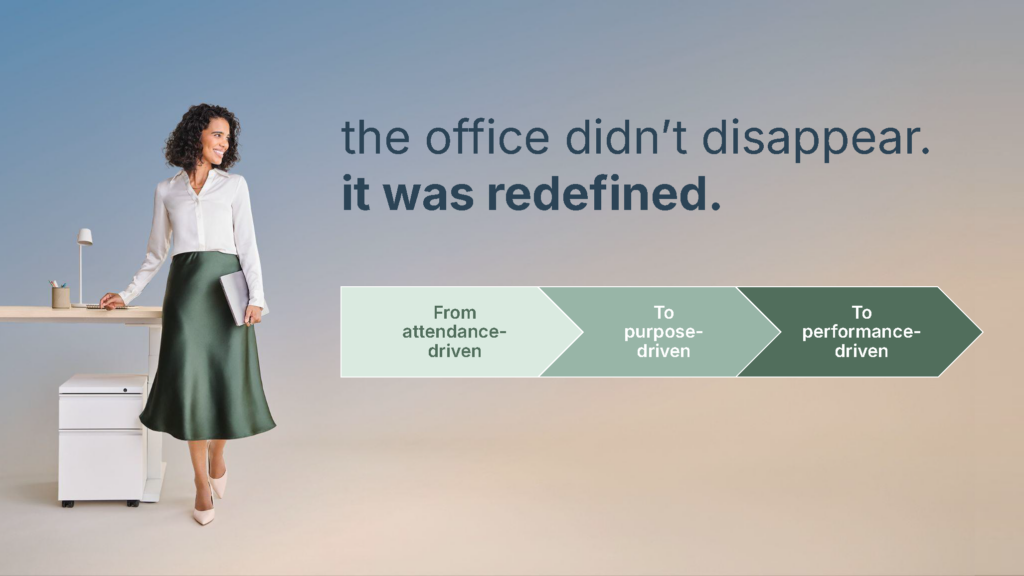
Remote work expanded rapidly, hybrid schedules became normalized and companies began rethinking how they use physical space. While workplace behavior changed, the role of the office evolved even more.
Today, the workplace is less about daily attendance and more about intentional use.
For small and midsize businesses, this shift presents both a challenge and an opportunity. Leaders must now think more strategically about how space supports their teams. The right environment can strengthen collaboration, reinforce company culture and signal professionalism to employees, clients and investors. In other words, the office has shifted from the default location for work to becoming a destination.
The Real Lessons Behind Your First Office
Despite its importance, office leasing can be intimidating for first-time tenants.
Many entrepreneurs focus primarily on rent when evaluating a space, but rent is only one component of total occupancy cost. In most cases, rent accounts for roughly 50–70% of occupancy costs, with the remainder covering furniture, IT infrastructure, utilities and operational support.
Failing to account for these additional costs can strain cash flow. In fact, studies show 82% of small business failures are tied to these challenges, rather than lack of demand.
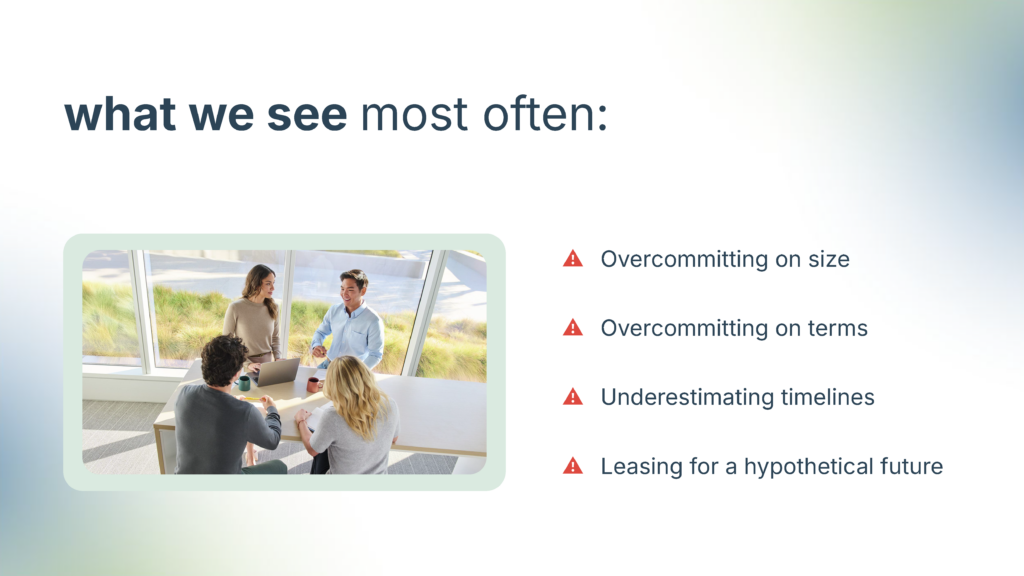
Another common mistake is overcommitting to space or lease length too early.
Many first-time tenants feel pressure to “get it right,” often choosing space based on where they expect the business to be in five years. But in today’s environment where market demand, talent needs and competition change quickly — planning too far ahead can become a constraint.
For many SMBs, prioritizing flexibility allows space decisions to evolve alongside the business. Traditional long-term leases may still suit larger enterprises or industries with stable headcount and predictable needs, but growing companies often benefit from planning around the next 12 to 24 months.
Why Flexible Office Models Are Growing
These challenges help explain why flexible office solutions have grown rapidly.
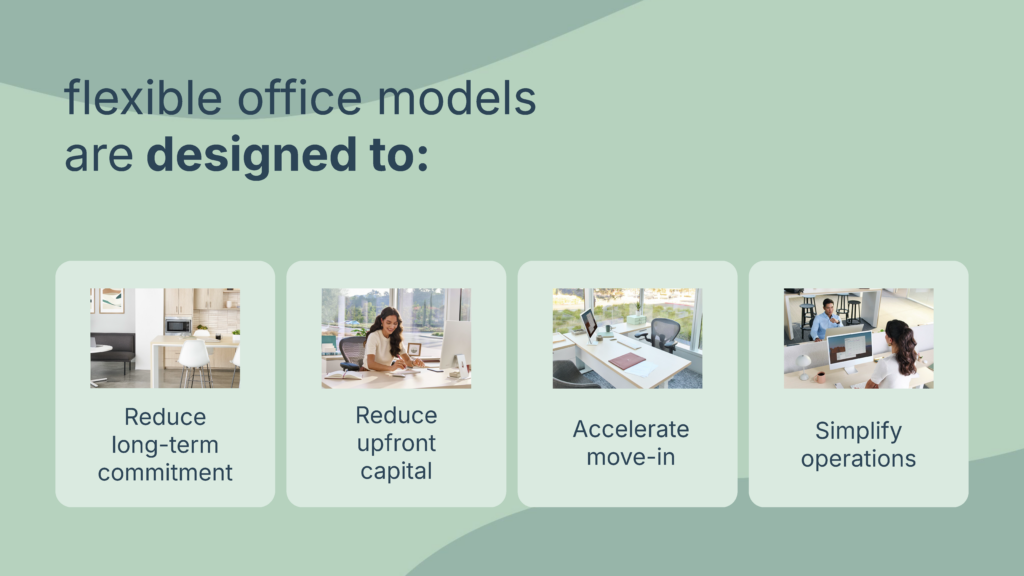
Flexible workspace models reduce upfront capital investment, shorten timelines and allow businesses to adapt as they grow.
Flexible office space has expanded significantly over the past decade. CBRE research shows supply has increased more than 600% since 2010, and although flex accounted for less than 2% of U.S. office inventory in 2021, 43% of occupiers said they expected to increase their use of it.
Importantly, flexible offices are not the same as coworking environments.
Coworking spaces are often designed for freelancers, independent professionals or teams of less than 5 people seeking shared resources and networking opportunities.
Private flexible offices, by contrast, are designed for established small and midsize businesses that need privacy and a professional environment to support onboarding, collaboration and brand credibility — without the long timelines and capital investment typically required for traditional offices.
Office Space Is a Strategic Decision
In competitive regions like California, workspace decisions are closely tied to talent strategy. Commute time, location and access to amenities all influence whether employees consistently use the office.
Research also shows that workplace design affects performance. Studies cited by Harvard Business Review suggest well-designed collaborative environments can accelerate decision-making and strengthen day-to-day team interaction.
Companies that approach office space strategically make clearer decisions about location, layout and lease structure. They are not simply choosing the biggest footprint — they are selecting environments that help their teams perform better.
A New Mindset for Business Leaders
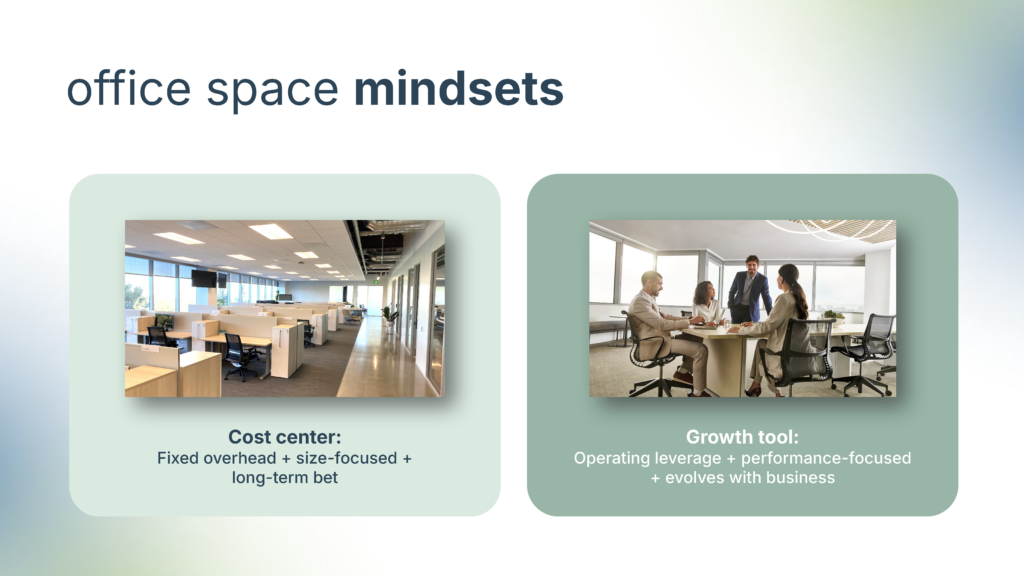
Ultimately, the biggest shift for small businesses is not just how office space is designed, but how it is viewed.
When leaders approach workplace decisions with a growth mindset, space becomes a catalyst for momentum rather than a constraint.
The most successful companies are not chasing the largest footprint or the longest lease. Instead, they focus on environments that help their teams collaborate, adapt and perform for today and as the business grows.
Watch the full webinar featuring Gavin Galey, Senior Leasing Director, and Kelly Micco, Vice President of Flex+, where they discuss how SMBs are using the workplace as a competitive advantage.